Alternative Fuels Are Changing the Conditions Under Which Kiln Coating Forms, Stabilizes and Fails. The Chemistry Is Only Half the Story.
By Jonathan Rowland
We think of the refractory lining as the thing that protects the kiln shell. But it doesn’t work alone. In the burning zone, a coating of partially molten clinker forms over the refractory. Typically, 10-25 mm thick, this coating creates an autogenous barrier that reflects heat into the process, reducing heat loss and shields the refractory lining from thermal and chemical attack.
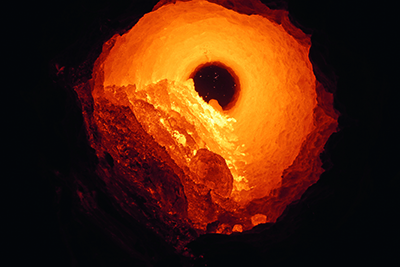
None of this is guaranteed and when it fails, the costs show up quickly. An unstable coating can increase heat losses through the kiln shell by around 15%, according to Tahir Abbas of combustion consultancy CINAR, before accounting for the refractory it protects or the unplanned stops that follow. But this coating is not a fixed layer. It forms only where the liquid phase in the feed meets the lining under the right conditions, and it holds only while those conditions hold.
And conditions are changing. As cement producers push thermal substitution rates upward, they alter both the chemistry entering the kiln and the consistency of the heat released inside it. Cement Optimized asked four experts how alternative fuels impact coating behavior and what refractory selection, fuel management and process control can and cannot do about it.
How Alternative Fuels Change The Chemistry
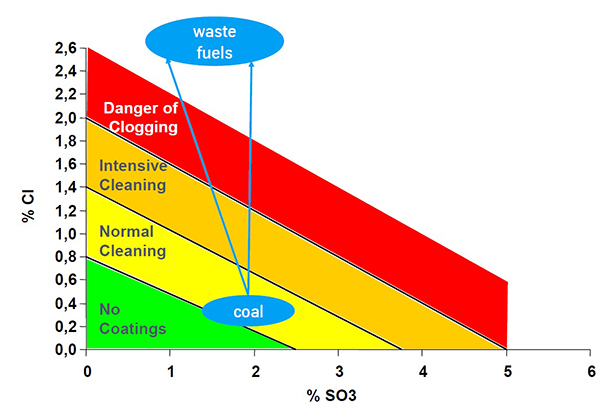
Chemistry is the part that most plant engineers already know. Waste-derived fuels bring chlorine into the kiln at concentrations conventional fuels never did: thyssenkrupp Polysius put typical refuse-derived fuel (RDF) at 0.8-1% chlorine, compared with less than 0.3% for coal. They increase alkali and sulfur levels in the kiln. Once present in the process, these volatiles cycle, accumulating with each pass unless something purges them.
The most visible symptom of this chemical change is blockage-causing buildup in the preheater — but that is not the only one. According to Abbas, chlorine combines preferentially with alkalis, shifting the sulfur-to-alkali balance and pushing the kiln toward hard-burning conditions under which coating forms poorly. Biomass ash, high in potassium and sodium, feeds the same volatile cycle.
These changes matter because coating stability depends on a relatively narrow chemical window. Conditions that promote volatile cycling and hard burning can disrupt the formation and retention of the protective coating in the burning zone. When the balance shifts too far, coating becomes more difficult to establish and maintain, increasing the likelihood of coating loss or uneven buildup.
The damage is not limited to the kiln coating. Volatiles penetrate porous refractory and degrade its internal structure, noted John Kline of Kline Consulting, while chlorine corrodes the shell itself in the burning and upper transition zones. From the refractory side, Tom Stroia of RHI Magnesita pointed to the same chemical imbalance, adding that the alkali-to-sulfur molar ratio is among the most useful diagnostics a plant can use to anticipate refractory performance and lining life.
Why Chemistry Isn’t the Whole Story
If the story ended there, it would be manageable. Kilns have always run difficult fuels; high-sulfur petcoke did not defeat the industry. As Kline put it, alternative fuels may not greatly impact coating behavior “if consistent in chemistry and as-fired thermal value.”
But there is also a data gap. Plants handle multiple alternative fuel streams, said Samuel Zühlsdorf, a fuel substitution specialist at thyssenkrupp Polysius, who recalled one operation that drew on 22 different suppliers for a single fuel type.
Yet the precise combustion behavior of an alternative fuel is essentially unknown until it burns. Online measurement systems are commercially available; however, they have yet to achieve widespread adoption in cement plants. In practice, plants sample fuel at delivery and again before firing, then estimate how the process will respond.
This is what differentiates alternative fuels from conventional ones. A known difficulty can be engineered around; a kiln can be set up for a demanding fuel and run on it steadily. What is much harder to handle is a fuel whose behavior changes faster than the process can be adjusted, and that, rather than any single property of the fuel, is what alternative fuels introduce.
That unpredictability compounds in the burning zone. Fuel with a lower calorific value or a larger particle size lengthens the flame. Thermal input rises and falls with each delivery. As Kline noted, these fluctuations alter the kiln’s thermal profile, affecting both clinker reactivity and the conditions under which coating forms and remains stable.
The result is a burning zone that stretches and contracts over time. As its position shifts, so too does the narrow thermal window on which a stable coating depends. This migration can lead to the formation of a sinter ring at the uphill edge of the burning zone, Kline said, as the protective coating builds preferentially in conditions that favor its growth until it becomes an obstruction. The coating fails because the thermal window on which it depends no longer remains stable.
The Pivotal Role of the Burner
Coating is conventionally described as sitting at the intersection of three variables: combustion conditions, refractory selection and process chemistry. Abbas was specific about which of the three leads. “The most important role at the intersection,” he argued, “is that of the kiln burner.” The burner mixes fuel with secondary air, creating internal and external recirculation zones that determine the length and shape of the flame, and thus the combustion and mineral interactions that occur inside the kiln.
A compact, symmetrical flame is the ideal. When the flame becomes detached or fluctuates, or fuel burns close to the kiln charge and/or walls, the coating may become unstable or detach. Both Abbas and Kline described the example of coarse fuel particles or ash falling into the clinker bed, disrupting local combustion conditions and mineral interactions on which stable coating and clinker quality depend.
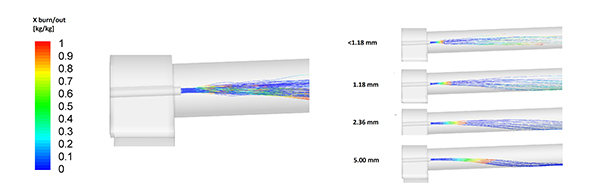
Zühlsdorf framed the same challenge in engineering terms. The challenge, he said, is to release the heat “at the right spot.” Solid alternative fuels must ignite as they leave the burner tip, before falling into the clinker bed. That typically means separate fuel channels with independently controllable primary air and — above roughly 50% substitution — satellite pipes that inject fuel alongside the main burner to buy additional residence time and improve distribution across the kiln cross-section. Kilns running on this principle, he said, have reached 100% thermal substitution.
In addition, Abbas suggested limiting the substitution rate to what the fuel quality can actually support and, where needed, using trace oxygen or hydrogen as combustion enhancers to ignite alternative fuel chips earlier and pull the flame back into a compact, attached form near the burner tip.
Managing What Cannot Be Measured
If the quality of alternative fuel cannot be known with any precision in advance, the response is built around absorbing variance rather than eliminating it. According to Zühlsdorf and Kline, the work begins upstream of the burner with active fuel management, including blending fuels to create as homogeneous a mix as possible and maintaining a trim fuel to stabilize thermal input.
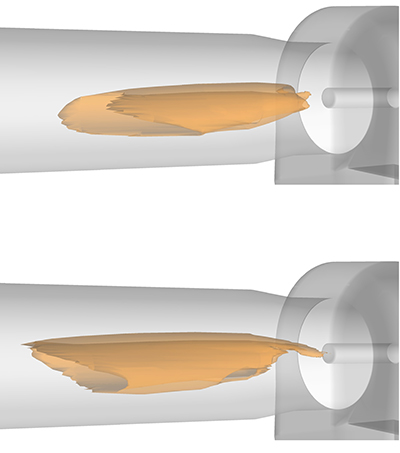
Combustion-system design matters as well. Consistent heat release depends on complete fuel burnout, sufficient oxygen availability, adequate residence time, and proper mixing between fuel and air. As substitution rates increase, systems originally designed around a single fuel type may operate beyond their intended limits, contributing to the fluctuations operators are trying to control.
Kline expects fuel preprocessing, drying and combustion systems located outside the clinkerization process to become increasingly important to maintaining kiln stability as lower-quality, higher-moisture fuels enter the cement industry.
For chlorine, the answer is more direct. Plants burning a significant fraction of chlorinated fuels, Kline said, should have a bypass in place to strip it from the system. According to thyssenkrupp Polysius, operational experience with an installed bypass permits up to three times higher chlorine intake. The caveat is that bypass dust then has to go somewhere — back to the cement mill or to disposal: a cost — and one that grows with substitution rate.
And because the conditions inside the kiln cannot be directly measured, plants are left to read the shell. Abbas pointed to thermal imaging and kiln shell scanning as the practical means of detecting coating loss and maintaining what remains, with flame trimming as the corrective lever. The variables themselves, he noted, “cannot be measured inside a cement kiln under its harsh combustion and turbulent conditions.” They are increasingly computed instead, through CFD modeling that establishes the firing limits a given fuel will support before the kiln has to discover them.
Whether AI can extend that further is, for now, constrained by the same problem as everything else in this section: a model can only optimize around an input it can characterize, and the fuel is not yet characterized in advance.
What the Refractory Lining Can and Cannot Do
If the chemistry is more aggressive and the thermal input less predictable, the obvious question is whether a better refractory can absorb the difference.
The answer is, partly. According to Stroia, refractory selection influences how readily coating forms, how well it survives thermal cycling, and how quickly it recovers after a collapse. Specify the wrong refractory lining for the zone and operating conditions, and the kiln effectively narrows its own operating window. Get it right, and that window widens, giving operators more tolerance for the fluctuations that accompany higher alternative fuel substitution rates.
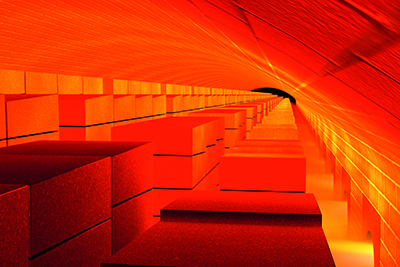
That tolerance increasingly depends on the refractory’s resistance to chemical attack. Stroia pointed to low porosity, low permeability and high density as particularly important characteristics for kilns operating with high thermal substitution rates. More sophisticated lining designs combine different refractory materials within the same zone — using techniques such as zebra striping, paneling and checkerboarding — to improve coating stability and limit alkali penetration into the brick.
These measures can help stabilize coating during changes in fuel quality and accommodate greater variability in the kiln feed. They can also reduce chemical attack associated with the higher alkali, sulfur and chlorine loads that often accompany increased alternative fuel usage.
There are limits, though. As Zühlsdorf noted, alternative fuels can attack refractory directly through moisture, acids and abrasion. Dense fuels such as tire chips may burn at unfavorable locations, generating localized temperatures that can damage almost any refractory lining.
The practical consequence is that plants operating at high substitution rates may find that some zones no longer last a full campaign and require intermediate repairs. A better refractory, in other words, buys tolerance rather than immunity. It can widen the operating window, but it cannot replace stable combustion, effective fuel management, or sound process control.
The Threshold
North American cement producers currently average thermal substitution rates well below those of their European counterparts. The average U.S. rate in 2023 was 16%, according to the American Cement Association, compared with an EU average of around 52% — with some European plants running at more than 80%.
That gap is variously explained as one of ambition, regulation or landfill economics. But it is also simply harder to push substitution rates upward than corporate roadmaps and sustainability reports tend to imply. Zühlsdorf identified a threshold at roughly 30% total substitution, corresponding to around 60% at the precalciner, beyond which the difficulties stop being additive and start compounding. Fuel variability rises, process fluctuations amplify, equipment margins narrow, and the demands on operators intensify at exactly the point where the process is least forgiving.
Beyond that threshold, coating stability becomes less a refractory or chemistry issue than a process-stability issue. The chemistry may still be manageable. The challenge is maintaining consistent combustion and heat release despite increasingly variable fuels.
Europe crossed that line years ago and learned what lay on the other side. Most North American plants remain below it. In that lies an advantage. Producers no longer need to discover these relationships for themselves. The effects of fuel variability on combustion, the effects of combustion on coating stability, and the limits of both refractory design and process control are now far better understood than they were when Europe began its own transition.
Ultimately, the lesson is a simple one. A healthy coating depends on consistency. The further substitution rates rise, the harder it becomes to maintain consistency — and the more valuable it becomes when achieved.
Managing High Alternative Fuel Substitution Rates
As alternative fuel substitution rates rise, fuel management becomes just as important as burner design or refractory selection. John Kline of Kline Consulting highlighted several priorities for plants looking to maintain stable operation under high-AFR conditions:
- Blend fuels to improve consistency. Whether undertaken onsite or by third-party suppliers, fuel blending helps create a more homogeneous feed and reduces sudden changes in heat input.
- Monitor fuel quality continuously. Online fuel monitoring can help maintain a more consistent thermal input and identify changes before they affect kiln performance.
- Maintain a trim fuel. A controllable, higher-quality fuel can compensate for fluctuations in alternative fuel quality and stabilize heat release.
- Ensure complete combustion. Alternative fuels must either be sufficiently fine or have sufficient residence time to burn out completely in the calciner or kiln flame.
- Provide sufficient oxygen. Fan capacity and airflow should be adequate to support complete burnout and prevent localized reducing conditions.
- Focus on fuel-air mixing. Good mixing remains fundamental to stable combustion, flame control and coating stability.
- Consider dedicated combustion systems. Additional combustion equipment, whether integrated into or separate from the clinkerization process, can improve burnout and expand fuel flexibility at high substitution rates.
Choosing the Refractory Lining
The rising use of alternative fuels and raw materials (AFR) raises several key considerations for refractory design and selection. Tom Stroia of RHI Magnesita set out where the decisions lie.
Consider the refractory materials carefully – Increased AFR use generally creates a more aggressive operating environment, and the refractories that cope best tend to share three properties: low porosity, low permeability and high density. Beyond that, Stroia pointed to bricks that encourage the formation of calcium zirconate (CaZrO₃), which maintains the spinel structure at elevated temperatures, limiting chemical infiltration and reducing the thermal conductivity of the lining.
Refractory selection also influences how readily coating forms and survives. According to Stroia, magnesia-spinel bricks bond to the coating via belite (C₂S), while dolomite bricks bond via alite (C₃S). The distinction influences how strongly coating adheres to the refractory lining, how well it tolerates thermal cycling, and how quickly it reforms after a collapse. For plants operating under variable fuel and process conditions, these differences can significantly affect coating stability and refractory performance.
Watch the alkali-to-sulfur ratio – High AFR rates and an imbalance between system alkalis and sulfur increase the tendency to build rings and drive more aggressive chemical attack: a quicker, deeper densification of the brick, often with cyclical spalling, that shortens the campaign. An alkali-to-sulfur (A/S) molar ratio of 1 is critical, Stroia said.
The imbalance can arrive from unexpected directions. Excess alkalis raise chemical attack on alumina linings at the back of the kiln and in the preheater tower. And a simple switch to natural gas, by reducing sulfur input, can tip the ratio the other way. Raising alumina content is not the recommended fix, with cost, higher shell temperatures, and only marginal improvement arguing against it.
Stroia’s preferred solution is a phosphate-bonded brick with a 55-60% alumina content, whose chemical bonding reduces susceptibility to attack and densification while improving thermal efficiency. Where excess sulfur is the problem instead, the remedy is a non-wetting alumina lining containing SiC or AZS materials, or dolomite panels set within the alumina lining.
Know your refractory lining – Fuel and raw material chemistry will fluctuate month to month, much of it outside the plant’s control, and Stroia was blunt that instability is becoming the norm rather than the exception. There is, he said, no silver bullet: each kiln needs a refractory solution tailored to its next campaign.
What helps is data. A 3D laser evaluation scan measures the lining and supports fast, fact-based decisions during shutdowns. A post-mortem analysis of worn or failed refractory, read against historical lining performance, establishes whether operating conditions should change. And a mechanical kiln audit assesses ovality and run-out from the refractory’s perspective — because a kiln running out of round will undermine even the best-specified lining.