Starstone Biomaterials and Ashtrom Industries have signed an industrial cooperation agreement to evaluate innovative biogenic cement technology. Under the agreement, Ashtrom Industries will evaluate the material’s performance and its potential integration into its operations, subject to compliance with regulatory standards and obtaining the required approvals.
Starstone Biomaterials is a deep-tech company developing the next generation of cement production. The company’s proprietary process utilizes engineered microorganisms as a biocatalyst within industrial bioreactors to produce biogenic vaterite, a highly reactive cementitious mineral, at low temperatures and without kilns.
The resulting material is marketed as “StarMix,” a low-carbon cement for direct integration into existing concrete production systems. Starstone’s technology directly addresses the urgent decarbonization targets set by the Global Cement and Concrete Association (GCCA) for the industry to reach net-zero emissions by 2050.
Gabriel Peer, co-founder and CEO of Starstone, said, “We aim to revolutionize the global construction industry through our unique technology. The collaboration with Ashtrom Industries will allow us to conduct industrial validation of our product and examine its integration potential into an efficient, low-carbon supply chain.”
Under the agreement, Ashtrom will conduct a comprehensive industrial pilot to test the material’s performance, its compatibility with existing production processes, and its compliance with relevant regulatory standards. Upon completion of the testing and receipt of the required approvals, the parties will examine the commercial integration of the material into Ashtrom Industries’ operations.
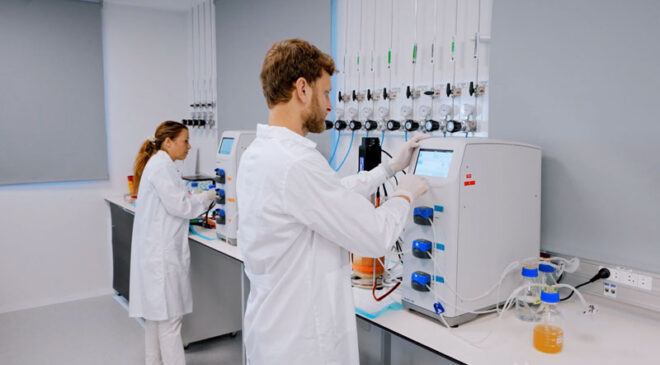
Starstone’s technology enables the production of cement and concrete using bacteria and fermentation systems inside industrial steel bioreactors, utilizing enzymatic processes and byproducts instead of quarried minerals and high-temperature burning.
This process is designed to reduce reliance on traditional, energy-intensive methods, which are considered one of the most significant sources of global carbon emissions.
The company utilizes genetically modified bacteria that undergo a fermentation process along with calcium, carbon dioxide and food industry waste, such as soy and oats. The resulting product is clean cement designed to integrate into existing production lines, subject to technical evaluation, operational adjustments and compliance with quality and regulatory standards.
“Our process eliminates the need for kiln heating and reduces energy consumption by up to 80% through a circular economy approach,” Peer said. “The collaboration with Ashtrom will allow us to test the technology in a real-world industrial environment and advance through the necessary validation stages. We are already in negotiations with European cement manufacturers and are exploring entry into the U.S. market.”
Sharon Leventer, CEO of Ashtrom Industries, stated, “Ashtrom Industries views the advancement of industrial innovation within the construction materials sector as highly important, along with the early evaluation of technologies that could impact how building materials are developed and manufactured in the future. The collaboration with Starstone reflects our ability to serve as an applied partner for technology companies — bridging laboratory development and industrial testing, while maintaining a strict focus on quality, standards, safety and performance. Based on the pilot results, we will evaluate the next steps and the potential integration of the material into the company’s operations.”
Ashtrom Industries Ltd. is the industrial arm of the Ashtrom Group, one of Israel’s leading construction, infrastructure and real estate groups, founded in 1963 and traded on the Tel Aviv Stock Exchange. Ashtrom Industries operates in the fields of construction materials, concrete, finishing materials, sealing and infrastructure. The company promotes the evaluation of innovative solutions that can be integrated into existing production processes while maintaining a strict commitment to quality, regulatory standards and safety.