Two groups tracking industrial carbon dioxide output detail a pathway for generating and selling environmental attribute certificates (EACs) backed by the reduction of CO2 emissions realized in processing or delivering low-carbon binders or mixes in their new document, “Book and Claim for Cement and Concrete.”
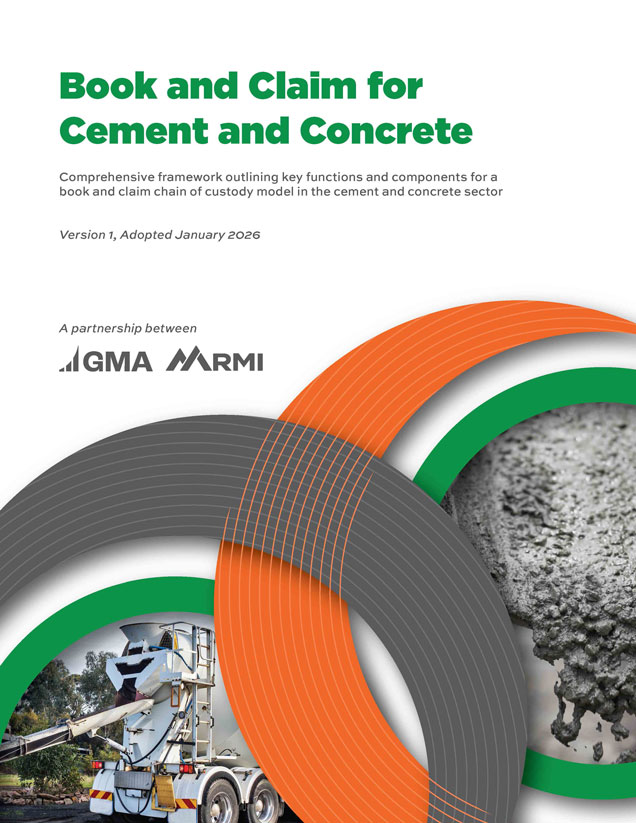
Taking a page from book and claim systems proved in sectors outside construction, RMI and Center for Green Market Activation propose a chain of custody model to instill confidence in a low-carbon cement or concrete EAC market. The model unlocks investments in low-carbon material production capacity while ensuring that financial flows are transparently linked to verified carbon emissions reduction.
“Book and Claim for Cement and Concrete” reflects a 15-month effort by RMI, GMA and a working group of 30 stakeholders to craft a framework for selling, buying, and retiring low-carbon cement or concrete EACs. Group participants included officials from CarbonCure Technologies, Cemex USA, Heidelberg Materials, (pre-Amrize) Holcim, Ozinga Bros. and the National Ready Mixed Concrete Association. RMI, GMA and group representatives hosted public meetings and a consultation period to collect additional input on the proposed system. Meetings and exchanges set these principles to guide a high-integrity and market-ready book and claim framework:
- Credible from an environmental standpoint, driving high-integrity atmospheric benefits.
- Usable and straightforward to facilitate scalable market transactions for low-carbon cement and/or concrete.
- Compatible with existing regulatory and non-regulatory frameworks and best practices.
- Comprehensive across a range of decarbonization solutions to ensure the book and claim system can support multiple viable pathways to low-carbon cement and concrete.
- Unifying so that it serves diverse geographic regions and markets, minimizing fragmentation and promoting geographic equity in access to decarbonization opportunities.
- Adaptable with an eye to longevity for future low-carbon technologies.
RMI and GMA officials view the six principles as setting the groundwork for credible future EAC transactions while allowing the market to grow, innovate, and adapt as low-carbon cement and concrete solutions scale. “Book and Claim for Cement and Concrete,” they contend, is designed as a foundation, versus endpoint, for a robust ecosystem. It launches with perspectives on market design considerations, book and claim transaction operational guidance, EAC issuance, and digital registry tracking, providing what authors note is “a sector-specific foundation to build confidence, enable investment, and support the decarbonization of cement and concrete at scale.”