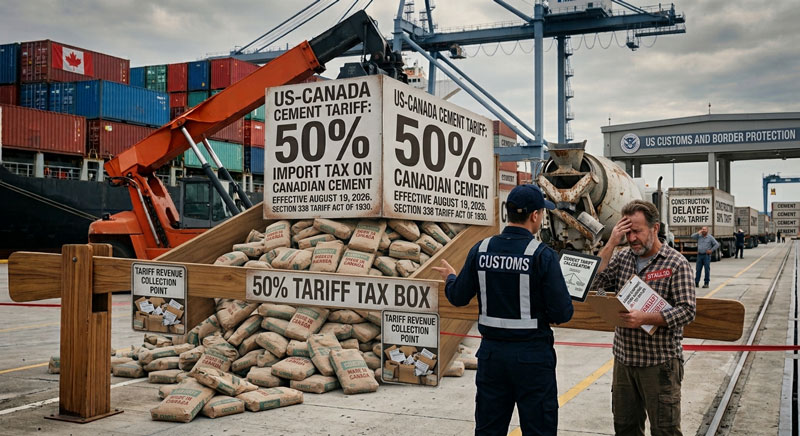
The United States announced a 50% tariff on Canadian cement, one of several products targeted for new tariffs. Taking effect on August 19, this measure allegedly stems from a trade dispute over cars, dairy and alcohol. Industry analysts expect this duty to increase regional construction and infrastructure costs.
“The important thing to understand about these tariffs, to put them in some context, is they cover about 5% of imports from Canada,” Natasha Sarin of the Yale Budget Lab told PBS. “And so they’re hugely important to the particular product lines that we’re talking about here.”
Tariffs on cement could impact projects from the cost of a residential driveway to massive public works projects, potentially resulting in cost overruns once the bidding process is complete.
“Despite what some may want you to believe, they get passed on to the end user, whether that’s a consumer or the owner of a construction project,” Mike Elmendorf, president and CEO of the Associated General Contractors of New York, said of the costs associated with tariffs.
“Make no mistake, [tariffs] will cause U.S. economic distress and adversely impact construction activity and cement consumption,” said Construction Materials Economist Ed Sullivan. He has spoken about landed cost increases, whether the costs are absorbed by the importer, and strategies undertaken to mitigate price increases.
The amount of added tariff costs that will be passed onto consumers will likely vary by region, state-by-state, and possibly within some states, according to Sullivan. The factors that determine the added costs for consumers center on the level of competition and the available alternatives to imports in the local market. Those more dependent on imports, may feel the sting of tariffs a bit more.
The American Cement Association position against proposed tariffs factors these cement import and consumption metrics:
- In 2025, Canada and Mexico account for 21% of U.S. cement imports and approximately 5% of U.S. cement consumption.
- The United States respectively imported 4.3 million and 0.5 million metric tons of cement from Canada and Mexico in 2025.
- Texas and Florida represent roughly 46% and 37% of Mexican imports’ port of entry, respectively, followed by Arizona (17% each), reflecting 2% of the states’ combined cement consumption.
- Canadian imports enter through New York (32%), New England (17%) and Washington & Oregon (14%), with the remaining 37% spread across Montana, North Dakota and other Great Lakes states. Those shipments account for upward of one-third the cement consumed in the combined states.