The recent visit of Philippe Richart, CEO of the World Cement Association (WCA), to CHOVET’s offices in Villeurbanne, France, provided the company an opportunity to reflect on more than six decades of commitment to the cement industry and on the increasingly central role of engineering in the sector’s decarbonization.
Since its foundation in 1963, CHOVET has been supporting process industries, with particular expertise in cement, lime, minerals and construction materials. Over the decades, technologies have evolved, performance requirements have become more demanding and industrial plants have undergone profound changes.
Yet the role of engineering has remained central: understanding processes, working with complex industrial assets, and turning manufacturers’ ambitions into solutions that are both technically feasible and economically viable.
Today, the cement industry is embarking on a new transformation on an unprecedented scale: decarbonization. Decarbonization means transforming cement production assets, the company stated.
For the cement industry, meeting CO₂ emission reduction targets will not rely on any single solution. Reducing energy consumption, changing the fuel mix, incorporating new raw materials, optimizing processes, introducing new equipment and adapting existing facilities: each plant must define its own pathway.
Innovation and emerging technologies can only deliver their full potential when successfully integrated into industrial reality. Solutions need to be properly sized and engineered, integrated into plants that may have been operating for decades, implemented without compromising production continuity, delivered within investment constraints and ultimately designed to achieve the expected performance.
It is precisely at this interface between environmental ambition and industrial reality that CHOVET’s engineering expertise comes into play. Engaging with WCA since 2023 This transformation naturally extends far beyond national borders. It was with this perspective that CHOVET joined WCA in 2023. Membership enables the company to contribute to international discussions on the future of the cement sector, share first-hand industrial experience and closely follow the emergence of new solutions and technologies.
The meeting between Richart and Damien Michel, CEO of CHOVET, is very much part of this ongoing dialogue, the company stated. It comes at a time when cement producers need to accelerate their decarbonization strategies while addressing significant challenges in terms of competitiveness, investment and operational performance.
In this context, dialogue between industrial operators, engineering companies, technology providers and international organizations is becoming increasingly important. The transformation of the cement industry will inevitably depend on the ability to share experience and turn innovation into practical industrial solutions.
This approach includes exploring solutions that enable processes to evolve while making the best possible use of existing assets. Energy optimization, alternative raw materials, clinker factor reduction and the adaptation of grinding technologies are among the many levers that can be combined according to the specific characteristics of each plant.
The objective remains the same: to identify solutions that deliver meaningful environmental performance while remaining realistic in terms of investment, operation and industrial implementation.
For CHOVET, this reflects an engineering philosophy developed over more than sixty years: starting from industrial reality on the ground. Today, this philosophy is embodied in CHOVET’s concept of “Reality-Based Co-Engineering”: jointly assessing challenges with clients, jointly selecting the most appropriate solutions by balancing carbon performance, technical feasibility, CAPEX and return on investment and ultimately working together to deliver solutions that can be successfully implemented in practice.
This engineering culture provides a solid foundation from which to address the next stages in the cement industry’s transformation. Because while technologies may change, one fundamental reality remains: industrial transition cannot simply be decided. It has to be engineered, process by process and plant by plant.
This is where CHOVET intends to continue bringing its expertise, working alongside the World Cement Association and industry stakeholders to help shape a cement industry that is both more competitive and lower-carbon.
“For us, collaboration starts with our clients and the realities of each plant. We work together to assess challenges, select solutions that balance carbon performance, technical feasibility, investment and return, and deliver them in practice. Our engagement with the WCA extends that exchange across the international cement sector, where sharing experience can help practical ideas travel further,” said Michel.
“The cement industry cannot decarbonize in isolation. Progress depends on collaboration between producers, engineering companies, technology providers and international organizations. Our dialogue with CHOVET brings an experienced engineering perspective into that exchange and helps connect decarbonization ambitions with the realities of existing plants,” commented Richart.
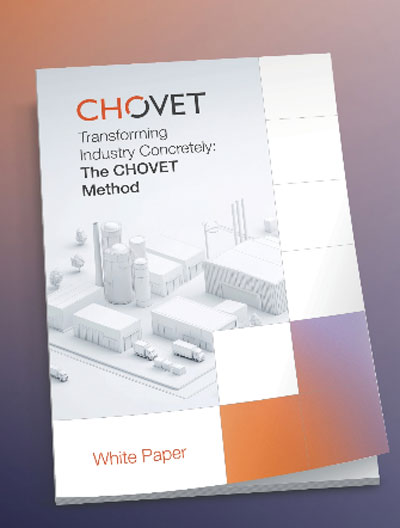
Download the white paper ’’Transforming Industry Concretely: The CHOVET Method,’’ a pragmatic approach to accelerating industrial decarbonization and supporting manufacturers in implementing operational solutions.