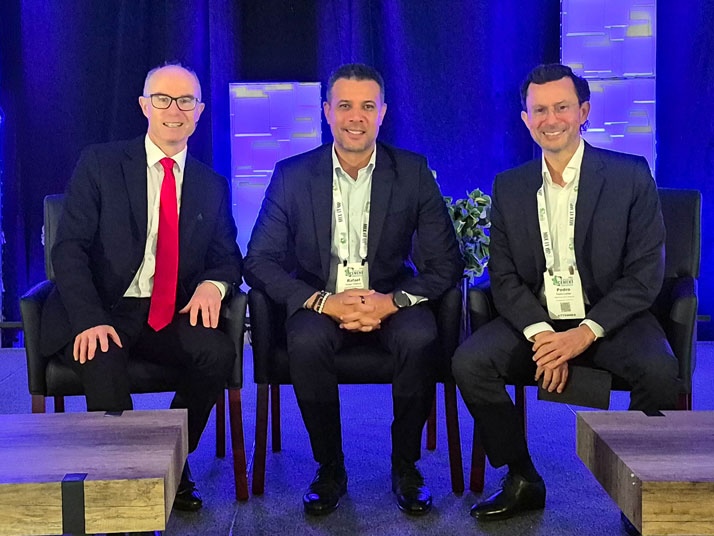
Officials from Peru’s Unacem Corp. updated 2026 IEEE-IAS/ACA Cement Conference attendees on priorities for their U.S. flagship business, Scottsdale, Ariz.-based Drake Cement, and sister Unacem North America properties in Arizona, Nevada and California. The latter is home to the Tehachapi cement plant acquired in 2023 from Martin Marietta Materials.
Unacem executives anchored a session, “Two Markets, One Industry: Global Leadership Perspectives in Cement,” at the Broward County Convention Center in Fort Lauderdale, host venue of the late-April IEEE-IAS/ACA gathering. Global CEO Pedro Lerner led off by noting the company’s plan to observe 20 years in the U.S. The milestone stems from the acquisition of Drake Cement in 2007 – then an entity permitting a 750,000-tpy greenfield plant in Paulden, Ariz. Since the start of production, Unacem North America has bolted on desert ready mixed and aggregate properties in Arizona and Nevada, leading into the Tehachapi plant transaction. More recently, it has increased Drake Cement grinding capacity by 300,000 tons with a new vertical mill geared to finishing natural pozzolan from a company-owned, northern Arizona deposit.
Drake Cement has launched the natural pozzolan as a supplementary cementitious material to augment or replace fly ash, supply of which has been hampered in West Coast markets with the retirement of key coal-fired power generating stations. The product is gaining traction among ready mixed producer accounts, consistent with a broader “rediscovery” of natural pozzolans after a 50-year lull in demand from West Coast concrete practitioners.
Unacem North America CEO Rafael Villalona told Cement Conference attendees that 2026 is emerging as an inflection point, a final year of flat or declining volume in Nevada and California markets. The prospect for lower interest rates and action on housing shortages bodes well for those markets, while Arizona – more stable in recent years – sees favorable material demand tied to data center developments and construction supporting strong copper mining activity.
Villalona emphasized present investment in building a culture throughout the Arizona, Nevada and California cement, concrete and aggregate sites. “Our priority is human capital and making sure we are the safest operator in the industry.” A focus on “hiring to retire,” he added, drives management to look for ways to make cement and concrete workplaces attractive to recruits.
He and his colleagues see 2026 as a year “to invest in people and the right projects to give the right returns and stay ahead of the curve for responding to market mandates and regulations. This is a time to pause, think, rethink, rewrite the script if needed, and be flexible in terms of adapting.”