Terra CO2 Technology Advances Texas Project While Building New Headquarters,R&D And Testing Facility Toward Commercial OPUS SCM Production In 2027.
by Don Marsh
Two construction milestones are underway for alternative cementitious materials developer Terra CO Technology Holdings. Backed with commitments from a $147.6 million Series B funding round, closed in March 2026, plus a U.S. Department of Energy Office of Critical Minerals and Energy Innovation grant award of up to $52.6 million, the company is breaking ground on a 32,000-sq.-ft. headquarters, R&D center and materials testing lab in Golden, Colo.
The Denver suburb is home to charter administrative and technical facilities and a 1-tpd capacity plant with a three-year record of yielding specification-grade OPUS SCM, a flagship binder, plus companion OPUS suite agents.
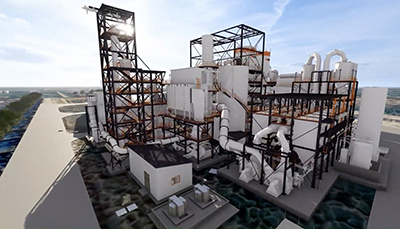
The new facility will enable further refinement of processing technology where silicate-rich feedstocks are milled, vitrified, and quenched, netting supplementary cementitious materials consistent with ASTM C-618, Standard Specification for Coal Ash and Raw or Calcined Natural Pozzolan for Use in Concrete and C-1912, Standard Specification for Supplementary Cementitious Material for Use in Concrete.
Terra engineers will also be equipped to integrate emerging low-carbon energy sources into their production model – extending the OPUS suite value proposition of embodied carbon reduction.
Along with the headquarters, R&D and lab investment, Terra has added cement plant equipment and concrete materials testing veterans to its leadership team. Senior Vice President of Engineering Dwayne Holland, P.E. is an 18-year veteran of KHD Humboldt Wedag, where he gained cement plant design and project delivery expertise and most recently led the North American business.
“While I am proud of the work we accomplished at KHD, including a recent large plant project, I believe in Terra’s mission of decarbonizing cement and am looking forward to expanding the engineering team to help get us there,” he said. “Along with our proprietary assemblies, we integrate equipment that is well-known to the industry and widely available or even take advantage of existing equipment at a potential site.”
Technical Director Stephen Herald has arrived with two-plus decades at Amrize Ltd. and predecessor Holcim (US) businesses, advancing from field testing technician to regional technical responsibilities with broad exposure to concrete quality control and performance. At Terra, he will drive market development by overseeing OPUS suite materials’ state or local agency approvals and compliance with ASTM standards.
“Proving the suitability of local feedstocks is built into Terra’s DNA,” he noted. “It starts with rapid characterization at our advanced R&D lab using industry-leading instrumentation, and moves directly to our pilot plant, where we test tangible performance metrics in concrete. By backing this rapid adaptation with AASHTO-accredited lab processes and strict quality control standards, we ensure exceptional material consistency. That unwavering commitment to quality is exactly how we deliver trust and confidence to producers, engineers and agencies.”
Commercial March
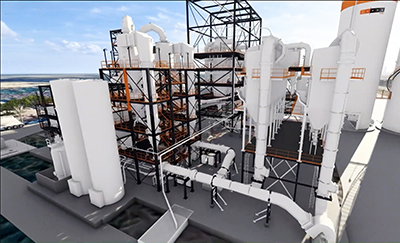
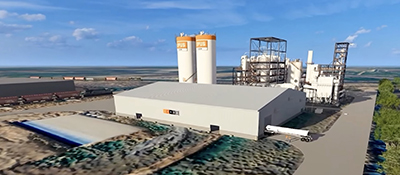
Holland, Herald and colleagues are overseeing the development of a premier OPUS SCM plant in Cleburn, Texas. At 240,000-tpy capacity, primarily for Dallas-Ft. Worth Metroplex concrete customers, the facility is on schedule, within budget and poised for a 2027 start up. It is being built under a process licensing and production partnership model with Asher Materials, a Southlake, Texas, supplier of carbon-minded structural and enclosure solutions.
The main Cleburn output will be OPUS SCM, which tests at rates up to 50 % of binder in commercial concrete mix designs. To prepare for a broader range of applications at lower dosage, Terra has measured OPUS SCM performance at 20% replacement rates in ASTM C150 Type I/II portland cement and C595 Type IL portland cement limestone mixes.
Lower early strength properties were observed with the Type IL + OPUS SCM versus the Type I/II + OPUS SCM mixes, but each converged to comparable strength levels at 28 days. The tests underscore a key factor as Terra and its partners secure approvals for use in public and private construction specifications: OPUS SCM is compatible with Type IL powder.
OPUS SCM uptake will compound the carbon dioxide emissions reduction efforts underlying widespread Type IL cement finishing and distribution. The absence or minimal presence of limestone in OPUS feedstocks significantly curtails the CO2 emissions attending portland cement clinker production.
Based on the template Terra has modeled for Asher Materials and forthcoming installations – where drying and vitrifying phases draw on natural gas fuels – OPUS SCM will exhibit a CO2 emissions factor of 450-600 lb./ton, offsetting higher carbon metrics of clinker.
Target Sites
Along with greenfield projects like Cleburne, Terra’s use of feedstocks gleaned from active quarries and lesser silicate material-bearing sources integrates with current production operations through drop-in processes.
“The industry needs solutions that perform reliably and can be deployed within today’s systems,” said Terra CEO Bill Yearsley. “This combination of scalability, accessibility and performance allows us to deliver cementitious materials that meet or exceed traditional standards – while dramatically reducing emissions. Progress over the past year reflects our commitment to this vision and disciplined focus on execution.”
Beyond Asher Materials, Terra is proceeding to shovel-ready status for six OPUS facilities across North America, aiming to make its low-carbon cement solutions available in major and high-growth markets. The latter includes Salt Lake City, site of a proposed operation that garnered the DOE Office of Critical Minerals and Energy Innovation grant.
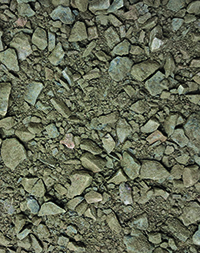
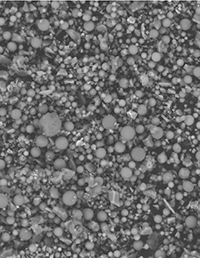
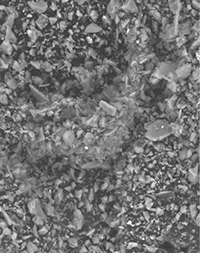
The feedstock to OPUS transformation, silicate-bearing materials are (from left) mined, milled and vitrified.